One of the fundamental parts of SEO is doing keyword research and doing it correctly. It is perhaps an area that is more complex than many people think and doesn’t just involve selecting the most popular keywords but choosing the right keywords. It is about finding your niche, keywords that suit that niche and ones that can rank highly for your given your budget.
As an SEO company in Bangkok, we know that creating content without keyword research is ineffective. You may write excellent content, but if it hasn’t been properly optimised, it is unlikely to yield results and traffic will be low. Keywords are what will ultimately drive traffic to your website.
How to Find Keywords
There are no hard and fast rules regarding how you should find keywords as there are many effective ways. The most common method of starting your search is to identify some “seed keywords”. From here, you can find related phrases which you can use in your content. So, if you were running a bridal shop, terms such as “wedding dresses”, “bridesmaid dresses” or “dress fitting” would all be appropriate.
Use Google
As discussed in the previous section, It may seem obvious, but typing a couple of words into Google’s search box and seeing what autocomplete suggests or using “People Also Ask” or “People Also Search For” will give you a good indication of what users are searching for.
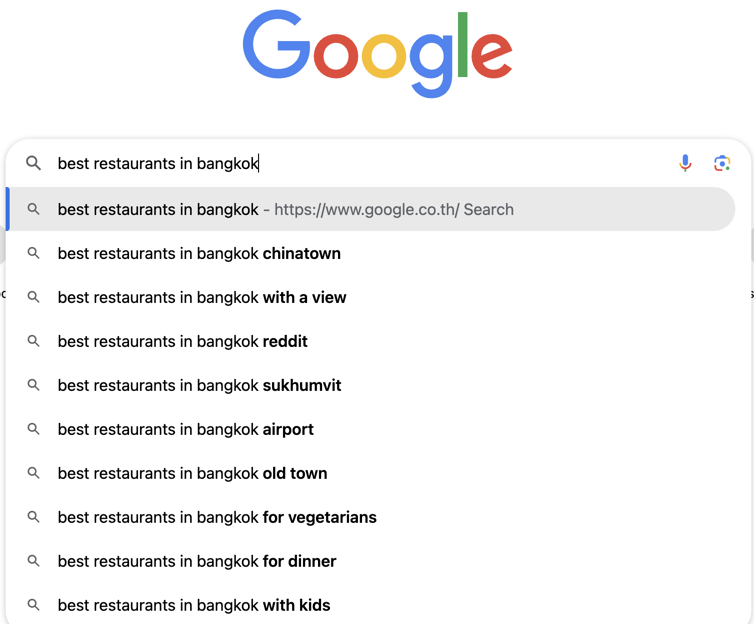
It is a quick process and can provide you with several ideas for keywords as well as titles for blogs.
Keyword tools
There are numerous free keyword tools available that can all give you hundreds of keywords based on the seed keyword. Although primarily designed for PPC, Google Keyword Planner is an excellent tool as is AnswerThePublic, although you are limited to the number of daily searches that you can submit. Free keyword tools for most people are sufficient, but if you have hundreds of potential keywords, you may need something more substantial.
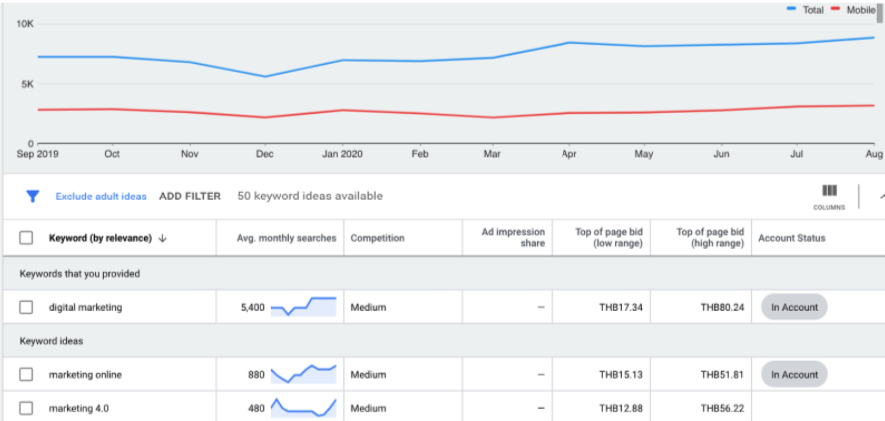
Paid tools like Ahrefs, SEMrush, or Moz offer far more insights, helping you decide which keywords to target. Although they can be quite costly, they will save you literally hours and, if used correctly, can give you a significant competitive advantage.
How to Conduct Competitor Analysis
Knowing what your competitors are doing is essential in SEO. Understanding which keywords they rank for can help you build your strategy. In order to achieve this, you may have to invest in a high-quality keyword tool, but over the forthcoming weeks and months, it will prove to be a worthwhile expense.
Other Search Platforms
Most of you will be aware that YouTube is regarded as the second most popular search tool, even if technically, it isn’t a search engine. It is a fantastic way to find out what questions people are asking about your niche and will give you ideas regarding content as well as keywords. Other useful platforms for keyword research include:
- Amazon (for global e-commerce) – it is the world’s third largest “search engine”
- TikTok (for similar reasons to YouTube, particularly if you have younger audience segments)
- Wikipedia
- Quora
- Industry forums or forums connected to your niche
Keyword Metrics
Gone are the days when those writing content focused solely on the keywords that had the highest search volumes. It would be best if you concentrated on the keywords that you want to rank highly for as they will be more relevant to your products, services or niche.
You may rank highly for a commonly searched term, but if in reality, it has little relevance to what you offer, it will serve little purpose. Google’s algorithm is becoming increasingly sophisticated, often penalising irrelevant content, which could lead to poor SEO performance.
What is Google RankBrain?
Introduced in 2015, RankBrain continues to be a core component of Google’s search algorithm in 2024 and its importance has only grown over time. It uses machine learning and artificial intelligence to better understand the intent behind user queries. This development means Google’s SERP results are more relevant, aligning closely with user expectations.
Long-tail keywords
Long-tail keywords will inevitably have lower search volumes, but this represents an opportunity rather than a challenge. These long and even middle tail keywords are likely to have more relevance, and those visitors that do visit your site are more likely to engage with you. As a result, conversion rates will be higher, and, of course, this is what you are looking to achieve.

Finding the balance between the number of searches per month, and relevance can be a challenge, and this is where the metric keyword difficulty comes into play.
In 2024, the use of long-tail keywords has become increasingly important as voice search continues to grow, and users tend to ask full, conversational queries.
Keyword Difficulty
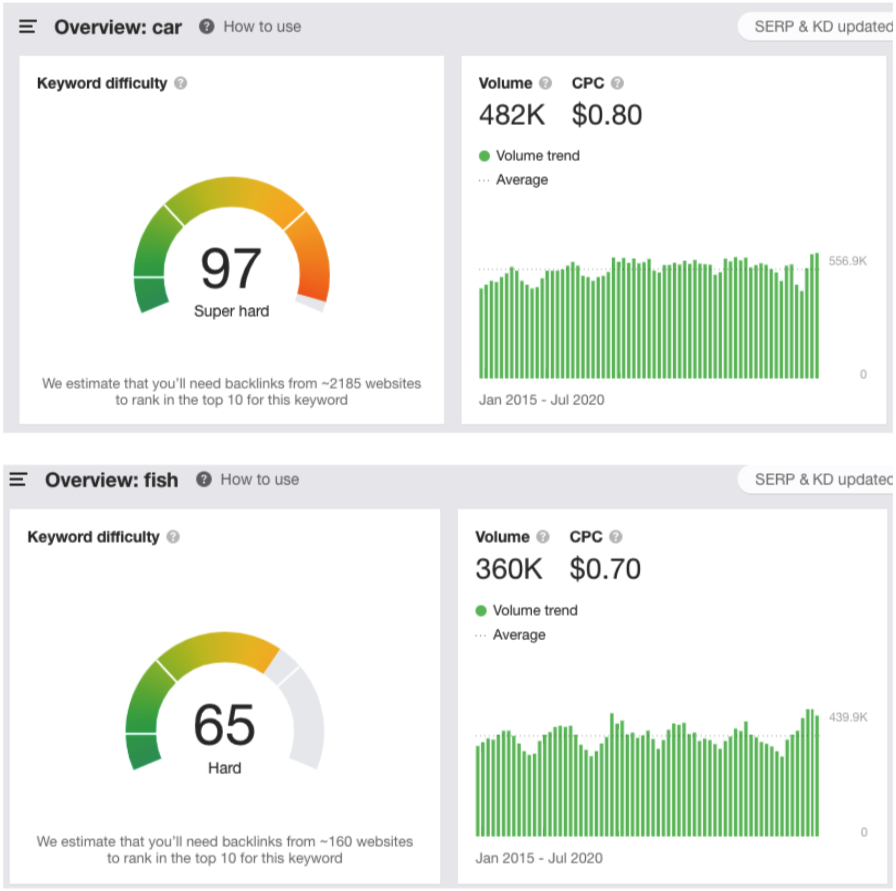
When choosing keywords, you need to be realistic about how easy it will be to rank highly for them. Of course, for very generic terms it is incredibly tricky to firstly rank highly and secondly, continually rank high. Using the metric keyword difficulty will help you to evaluate the likelihood of achieving first page rankings. Tools like Ahrefs provide a Keyword Difficulty (KD) score, ranking difficulty from 0 to 100.
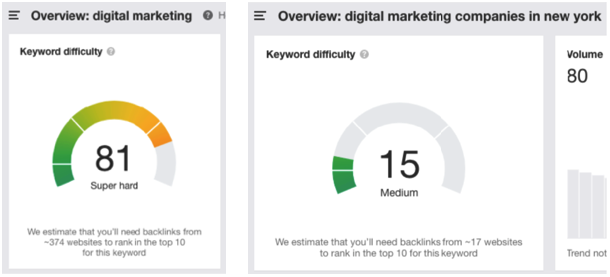
However, different tools may produce different KD scores. You could use three different tools and the same keyword, and you would be given different scores in each case (sometimes with differences as much as 50%). The reason for this is because the tools themselves use different algorithms and will almost certainly work to a different set of calculations. So, when you are doing your SEO, we strongly advise that you stick with one tool so that you are comparing “apples with apples”.
Search Intent in 2024
One of the most critical parts of any keyword research is doing SERPs analysis. It will help you to establish two crucial bits of information:
- You will be able to find who is ranking number one on the SERP and therefore build a strategy to challenge them
- You will be able to gain an understanding of the intent behind the search – search intent
Establishing the search intent is vital so that you don’t optimise the wrong words. For example, users searching for “how to bake a cake” clearly want a recipe, not an online shop for cakes.
As we identified in chapter two, there are different search intent variations. Aligning your keywords with the correct intent can significantly boost your SEO:
- Navigational – the user searches for a specific website or brand such as “Nike”.
- Informational – the user is looking for specific information such as “how to bake a cake”.
- Transactional – the user wishes to make a purchase such as “buy Nike Air”.
- Commercial – the user is researching a product before making a purchase such as “review of iPhone 16 Pro”.
For your website’s SEO, you must keep a sense of perspective on things. For example, if you had a blog about gourmet burgers, there would be little point investing all your time and money in ranking number one for “burgers”. You would be competing directly with the likes of McDonald’s and Burger King, while actually offering something very different.
Very few people search for the phrase “burgers” alone, it usually forms part of long-tail phrases such as “where can I get a great burger in Bangkok?” which would probably be more relevant. Ranking top in relevant results is far more important from a conversion point of view than ranking highly for frequently searched keywords.
Avoid Common Keyword Research Mistakes
One mistake SEO novices often make is focusing on keywords with high search volumes without considering relevance or difficulty. As we have mentioned above, focus on long-tail keywords that are more likely to bring relevant traffic.
Another common problem is that information is misinterpreted. For instance, as we mentioned earlier in this chapter, Google’s Keyword Planner is designed for Google Ads, so when it says “competition” it is referring to competition for that Google Ad keyword. It does not relate to how difficult it is to rank for that keyword organically.
Keyword Stuffing
Keyword stuffing is another trap that many inexperienced content writers fall into. This is repeatedly using the same keyword in your article to the extent to which it is very evident to the reader what the keyword is. Ideally, you will select one focus keyword and where possible, use it in:
- The title/heading
- The title tag and meta description
- One of the first two paragraphs
- Up to another couple of times in the main body of your text
Google focuses on the quality of the content, and this means that it is user-friendly, well-written and insightful. It has even been suggested that you may rank for keywords that haven’t been included in your text! Rather than repeatedly using the same keyword, we recommend using Latent Semantic Indexing (LSI) keywords.
LSI Keywords
Latent Semantic Indexing (LSI) keywords are terms related to your primary keyword. They usually alter depending on current trends but add substance to your text. In 2024, tools like LSI Graph remain useful for finding these related terms.
Keyword Mapping
Keyword Mapping is the process of identifying which keywords should be targeted to which page. This is a crucial step in any SEO campaign as you want to ensure the keywords are not conflicting causing ‘Keyword Cannibalisation”. This where there is more then one page that is relevant for the same keyword, which can confuse Google and ultimately result in poor rankings. We discuss Keyword Mapping in more detail here.
Key 2024 Updates for SEO
E-E-A-T: Google’s focus on Experience, Expertise, Authoritativeness, and Trustworthiness (E-E-A-T) has expanded. When conducting keyword research for content creation you need to be aware of this, especially in industries like health, finance, and law.
AI and Natural Language Processing: With AI-driven content and natural language processing advancing, using tools like ChatGPT in keyword research can improve relevance and search intent matching.
Contact us
For more information about keyword research or anything else connected to SEO or digital marketing, contact us on 02 038 5400.
- 1. How to find keywords
- 1.1. Use Google
- 1.2. Keyword tools
- 2. What are your competitors doing?
- 2.1. Other popular search platforms
- 2.2 Keyword metrics
- 3. What is Google RankBrain?
- 3.1. Long-tail keywords
- 3.2. Keyword difficulty
- 3.3 Search intent is playing a more prominent role
- 4. What NOT to do when doing keyword research!