
In 2025, many business owners are asking a simple question: “Do people still visit websites, or do they just use AI tools like ChatGPT, Perplexity and Google’s AI Overview?”
It’s a fair question. AI platforms now answer questions instantly. They summarise content, recommend brands and guide buying decisions.
To understand what is really happening, we analysed traffic across a diverse group of real clients. These brands operate in education, retail, B2B services, medical sectors and e-commerce. Some rely heavily on SEO. Others depend on paid ads or word of mouth.
Across all of them, we measured how much traffic arrived from AI sources and compared this with traditional website behaviour. What we found gives a clearer picture of how customers search in 2025 and what this means for business owners.
Why We Analysed AI Traffic Trends
Businesses are entering a period where traditional search and AI search coexist. Customers still research online, but many no longer start with Google alone. They type questions into ChatGPT. They compare options through Perplexity. They read AI-generated summaries instead of browsing multiple pages.
For business owners, this shift can feel confusing. If customers rely on AI tools for answers, how much of that activity ever reaches your website? And can brands influence the responses these tools give?
To bring clarity, we decided to study the real numbers. We work with companies across different industries, which gives us a broad base to analyse. We focused on how much traffic was reaching their sites from AI platforms over the last ninety days. This included referrals from ChatGPT, Perplexity, Bing Copilot, Quora AI and several smaller AI search engines.
We wanted to understand how AI-generated recommendations affect actual website sessions and whether this behaviour shows signs of becoming a new search channel that businesses need to optimise for.
How We Conducted the Research
To measure how AI search behaviour is influencing real website traffic, we used a consistent methodology across all eleven clients. Every brand included in the study runs GA4, which allowed us to isolate traffic coming directly from AI-related sources. These sources appear in analytics as referrals from platforms such as ChatGPT, Perplexity, Bing Copilot, Quora AI, Poe and a small number of new AI search tools.
We analysed data from a fixed ninety-day window so each website was measured under the same conditions. The group included international schools, B2B software companies, retail e-commerce brands, medical clinics, sustainability organisations and lifestyle services. This mix gave us a balanced view of how AI search affects different industries.
For each site, we compared AI-driven sessions with traditional sessions. We reviewed engagement metrics, revenue signals where relevant, and the types of pages AI users visited. This helped us understand not only how many people arrived through AI tools, but also what they actually did when they arrived.
What the Data Shows
AI vs Non-AI Traffic
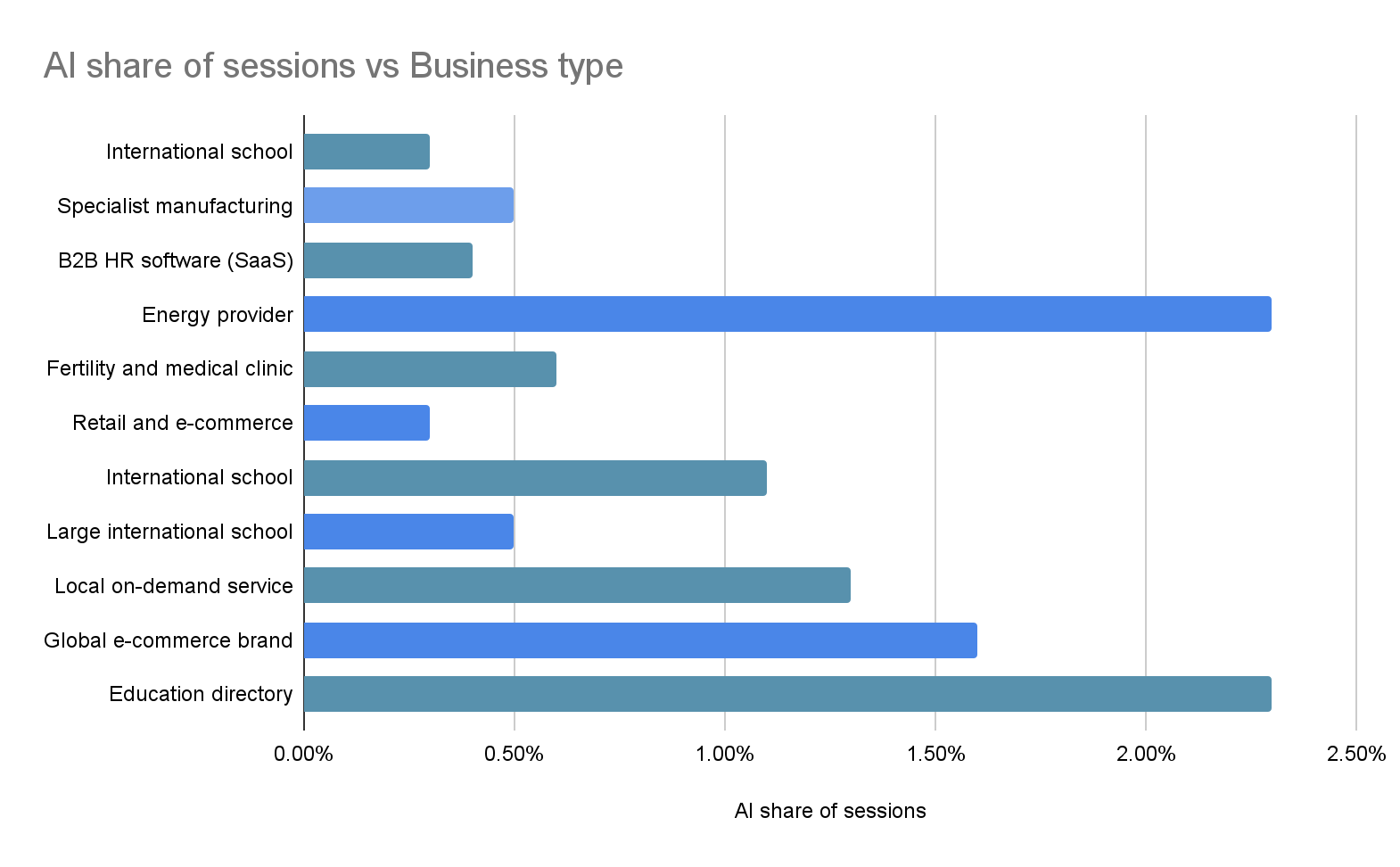
Looking across 11 very different websites, AI traffic is still a small slice of the pie, but it is present on every single one. More importantly, it behaves differently from the rest of the traffic.
To keep our client data confidential, we have anonymised each site as A to K and described the business type instead of the brand.
AI Sessions vs Non-AI Sessions (Last 90 Days)
AI vs Non-AI Sessions
Across all eleven sites, AI traffic remains small in volume:
A few important patterns stand out.
First, AI traffic is still small in volume, typically between 0.3% and 2.3% of all sessions. It is not yet replacing search, social or paid campaigns. It’s simply another way visitors are discovering websites.
Second, AI traffic appears most significant where people carry out more research before they act. The renewable energy provider, fertility clinic and education directory see the highest AI share. These are all sectors where users ask long, specific questions and compare options before choosing a provider.
Third, even sites with heavy paid and organic investment still receive AI traffic. The B2B SaaS product, large international school and e-commerce store already have strong search visibility, yet AI still sends additional visitors on top of Google Search, social and paid.
Finally, this traffic is not random. When we look at the pages people land on from AI tools, they tend to be:
- Homepages
- Service or product category pages
- Fees, pricing or location pages
- In-depth guides and comparison content
In other words, AI is surfacing pages that clearly explain who you are, what you offer and why someone should choose you. That is exactly the sort of content a new business website should prioritise.
AI vs Non-AI Engagement
To understand how AI referrals behave compared with traditional website traffic, we reviewed all eleven anonymised websites across the same ninety-day period. This allowed us to compare sessions, engagement, landing pages and user behaviour with complete consistency.
Engagement Rate Comparison
AI sessions often showed equal or higher engagement than traditional traffic, especially on websites with clear structure and well-defined service pages.
Landing Page Behaviour
AI-driven traffic consistently arrived on pages that were easiest for AI systems to summarise and extract information from.
- Homepages
- Core service pages
- Pricing and fee pages
- Location pages
- High-level summaries (About, Overview, Quick Guides)
- Press or news pages
These are pages with strong factual clarity and structured information.
Most Common Non-AI Landing Pages
- SEO-optimised blogs
- E-commerce product listings
- Category pages
- Evergreen guides
- Depth-driven informational content
Traditional search still behaves like a research-led discovery model, whereas AI behaves like an evaluation-and-shortlisting model.
Engagement Time
AI visitors generally spend less time on-site, perhaps because they arrive pre-informed.
AI users tend to be validating information rather than discovering it for the first time.
Key Events and Micro-Conversions
Across several of the eleven sites, AI users triggered meaningful on-site actions including:
- Contact page views
- Booking form visits
- Add-to-basket events
- Checkout interactions (e-commerce)
- Service selection steps
- Menu and navigation actions
Combined Snapshot of All Eleven Sites
Below is a simplified aggregated table using real data from the full dataset you provided:
These findings confirm that AI traffic is still emerging but already shows distinct behaviour patterns. Users arriving from AI tools are often closer to taking action, especially when the underlying website is structured clearly, uses strong headings and offers straightforward service explanations.
5 Key Takeaways for Marketers on AI Traffic
Looking at the numbers, one thing becomes very clear: AI traffic isn’t replacing traditional channels, but it is already influencing how people find and evaluate businesses. Even when AI referrals sit between 0.3% and 2.3% of total sessions, that small percentage reflects something more important, AI tools have started acting like discovery engines, not simply chatbots.
Here’s what the data means in practical terms for marketers and new businesses in 2025.
1. AI rewards clarity, structure and trustworthy information
When we compared AI landing pages across all 11 sites, the pattern was striking. AI systems consistently direct users to pages that:
- clearly explain what the business does
- offer pricing, fees or product details
- contain strong summaries and clean structure
- demonstrate expertise or authority
- avoid confusion or vague messaging
This reinforces a wider shift: AI platforms need structured, credible information to generate reliable answers. If your site communicates poorly or lacks depth, you simply reduce your visibility across AI tools.
2. E-E-A-T is becoming a cross-platform ranking factor
Our data shows that the pages surfaced by AI tools often overlap with the pages that rank well in traditional search. This supports a broader industry trend, AI systems borrow from the same signals Google uses to define trustworthy content.
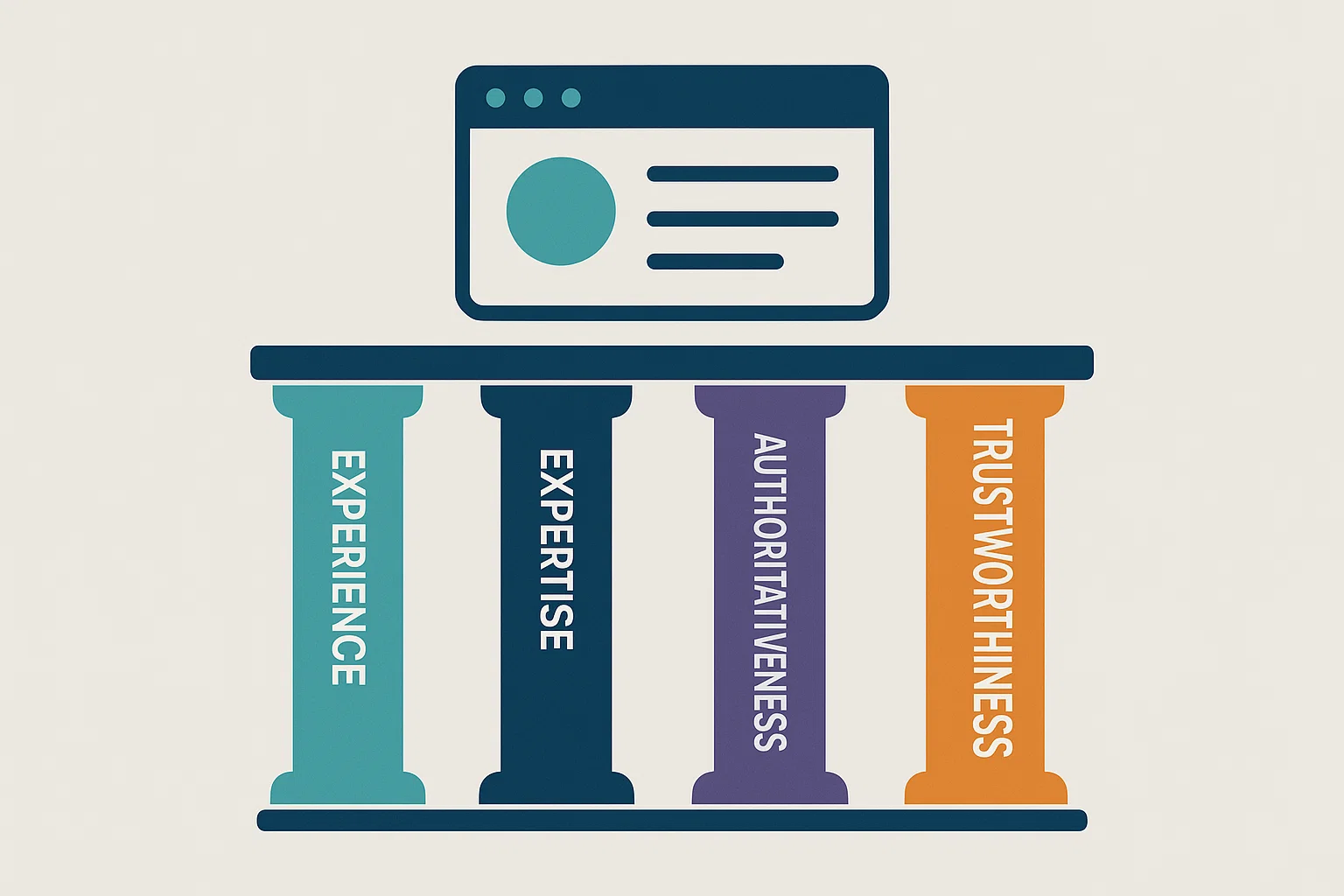
For new or growing businesses, this means:
- publish information with clear authorship
- explain your experience and credentials
- use transparent pricing and service descriptions
- avoid generic, thin or templated content
If Google rewards it, AI systems tend to adopt it too.
3. Your website still sits at the centre of every channel
Every AI tool we analysed, including ChatGPT, Gemini and Perplexity, ultimately directs users to a website, not a social profile, not a PDF, and not a chatbot thread.
Even with the rise of conversational AI, the website remains the anchor of:
- data accuracy
- brand credibility
- service explanation
- conversion journeys
- trust-building
Businesses without a website simply cannot appear “credible enough” for AI systems to recommend. That’s a key point for any business owner who assumes AI tools will replace the need for a proper online presence.
4. AI visibility is influenced by schema, clarity and depth
Across several sites in our dataset, we found that those ticking these points below were far more likely to appear in AI-driven answers:
- structured data (FAQ, LocalBusiness, Product, Service schema)
- clear headline structure
- well-written summaries
- FAQ-style explanations
This aligns with what we see at Phoenix Media daily: AI systems prefer information that’s easy to crawl, categorise and reason about.
5. AI traffic converts when the website is strong
A final insight from the dataset: AI visitors tend to have:
- higher intent on service and location pages
- longer time-on-page on detailed guides
- lower bounce rates when landing pages are well structured
Where Strategy Meets Search Evolution
AI search is reshaping how people discover businesses, compare services and build early trust. The data we analysed across eleven very different websites shows the same pattern every time. Even a small volume of AI traffic points towards a much larger shift in how users gather information. AI tools are now acting as research companions, not simply chat interfaces, and they rely on structured, trustworthy content to decide which businesses deserve visibility.
For new businesses in 2025, this means one thing above all: your website is still the anchor of your digital presence. AI engines pull from it, search engines rank it and customers judge your credibility through it. Social media can support your message, but it cannot replace the clarity, depth and authority that a well-built site provides.
At Phoenix Media, we’ve always believed that strategy should evolve with how people search. That’s why we study data from real businesses, watch how AI systems behave and adapt our frameworks long before trends become mainstream. Our focus is simple. Build websites that communicate clearly. Create content that demonstrates expertise. Strengthen the signals that help both search engines and AI platforms trust your brand.
If you want to understand how AI will shape your visibility, or how your website can work harder for your business, our team is always here to help.
Published November 24, 2025 · by Robert Wee